
About you
Weight and goal
Free Weight Loss Calculator: Instantly Find Your Daily Calories to Lose Weight
Most people start a diet the same way. They pick a number off the internet, like 1,200 calories, and hope it works. A few weeks later they’re tired and hungry, and the scale has barely moved.
The problem is that nobody eats the same amount, moves the same way or weighs the same. A calorie target that suits your friend can be far too low or too high for you. A weight loss calculator fixes that by building the number around your body and goal.
Below I’ll explain how this weight loss calculator works, how to read the results and how to use them without making the usual mistakes.
What Is a Weight Loss Calculator?
A weight loss calculator is a free tool that estimates how many calories you should eat each day to lose weight at a steady pace. You enter your age, gender, height, current weight and goal weight, then pick how active you are. It does the math and shows your plan.
Our weight loss calculator gives you:
- Your BMR (the calories your body burns at rest)
- Your maintenance calories (what you burn in a normal day)
- Your daily calorie target for weight loss
- Your BMI now and at your goal weight (you can also check it separately with our BMI calculator)
- How long it should take, plus an estimated goal date
How the Weight Loss Calculator Works
There’s no magic here. The weight loss calculator uses the Mifflin-St Jeor equation, which is widely used to estimate resting calorie burn. It looks at your weight, height, age and gender to work out your BMR.
Then it multiplies your BMR by an activity factor to get your maintenance calories. That’s roughly how much you can eat without gaining or losing weight.
| Activity level | Multiplier | Who it fits |
|---|---|---|
| Sedentary | 1.2 | Desk job, little or no exercise |
| Lightly active | 1.375 | Exercise 1 to 3 days a week |
| Moderately active | 1.55 | Exercise 3 to 5 days a week |
| Very active | 1.725 | Hard exercise 6 to 7 days a week |
| Extra active | 1.9 | Physical job plus regular training |
Be honest when you pick your activity level. Most people overestimate it, and that’s the quickest way to get a target that’s too high.
Finally, the calculator subtracts a daily calorie deficit based on the pace you choose. It uses the common estimate that about 7,700 calories equals one kilogram of body weight.
A Real Example Using the Weight Loss Calculator
Take a 30-year-old man who is 170 cm tall and weighs 85 kg. He exercises a couple of days a week and wants to reach 75 kg.
- His BMR comes to about 1,768 calories.
- With a lightly active lifestyle, his maintenance is about 2,430 calories.
- At a steady pace of 0.5 kg a week, he needs a deficit of about 550 calories a day.
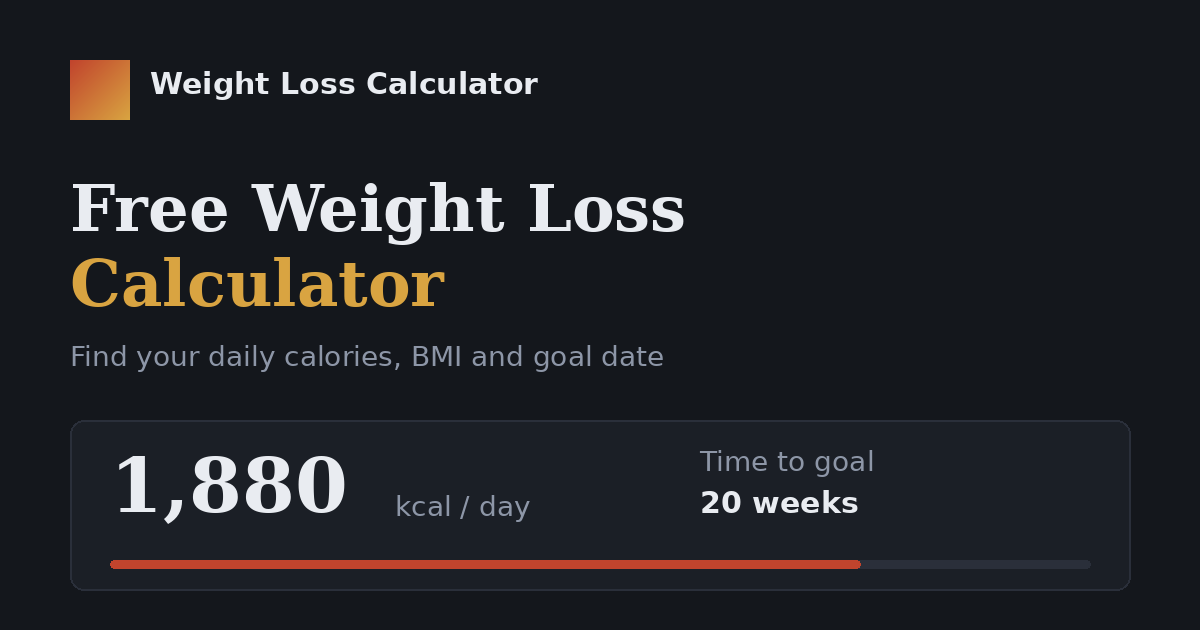
- His target is around 1,880 calories a day.
- He has 10 kg to lose, so he should reach his goal in about 20 weeks.
That’s a sensible plan. It doesn’t ask him to starve, and it fits into a normal week of eating.
Which Pace Should You Choose in the Weight Loss Calculator?
The pace you pick changes both your calories and your timeline. Here’s what it looks like for someone who wants to lose 10 kg:
| Pace | Daily deficit | Time to lose 10 kg | Who it suits |
|---|---|---|---|
| 0.25 kg per week | About 275 kcal | About 40 weeks | Beginners, or anyone who wants it easy |
| 0.5 kg per week | About 550 kcal | About 20 weeks | Most people |
| 0.75 kg per week | About 825 kcal | About 14 weeks | People with a lot to lose |
| 1 kg per week | About 1,100 kcal | About 10 weeks | Short-term and only with a larger starting weight |
A pace of 0.5 kg per week is a solid default. The CDC says people who lose weight gradually, about 1 to 2 pounds a week, are more successful at keeping it off. That’s roughly 0.5 to 1 kg a week, which matches the middle of the table. Faster isn’t always better. Crash diets often end with the weight coming straight back.
Why the Weight Loss Calculator Won’t Go Too Low
You may notice that the calculator raises your calories if the plan would drop too far. It never goes below 1,500 calories for men or 1,200 for women. Eating less than that without medical supervision can lead to tiredness, nutrient gaps and lost muscle.
If that happens, the tool shows a slower, safer timeline instead.
What Does Your BMI Result Mean?
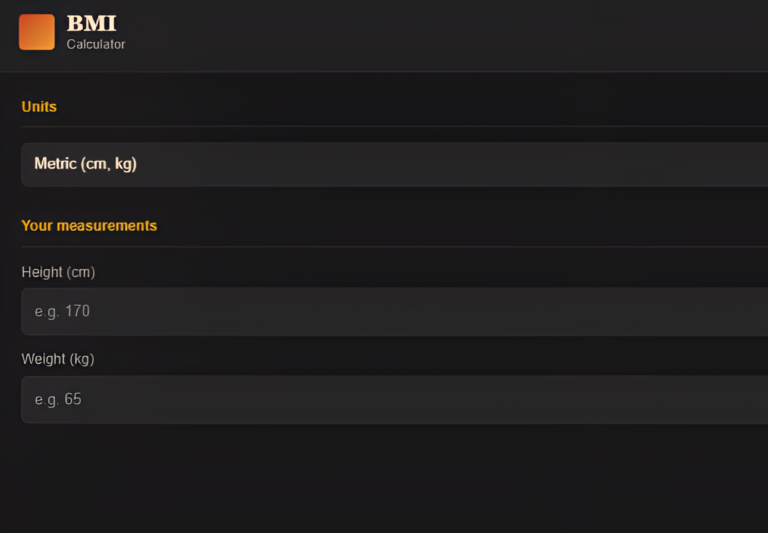
BMI compares your weight to your height. It’s a quick screening number, not a verdict on your health. If you only want that number, try our free BMI calculator.
| BMI | Category |
|---|---|
| Below 18.5 | Underweight |
| 18.5 to 24.9 | Healthy range |
| 25 to 29.9 | Overweight |
| 30 and above | Obese range |
These ranges follow the CDC’s adult BMI categories. BMI doesn’t separate muscle from fat, so athletes and very muscular people can look “overweight” when they aren’t. Use it as a guide, along with how your clothes fit and how you feel.
Tips to Get More From Your Weight Loss Calculator Results
- Recalculate as you lose weight. A lighter body burns fewer calories, so update your numbers every 5 kg or so.
- Track for two weeks. Log what you eat honestly. Small bites and drinks add up fast.
- Eat enough protein. It keeps you full and helps protect muscle while you lose fat.
- Don’t panic over daily changes. Water, salt and sleep can move the scale by a kilo overnight. Watch the weekly trend.
- Move more, but don’t overdo it. A daily walk is easier to keep than an intense plan you drop after ten days.
Frequently Asked Questions
Is this weight loss calculator accurate?
It gives a solid estimate, but it’s still an estimate. Everyone’s metabolism differs a little, so treat the result as a starting point and adjust after two to three weeks based on your progress.
How many calories should I eat to lose weight?
It depends on your age, size and activity. Most people lose weight eating 500 to 750 calories below their maintenance level.
Can I use it if I’m pregnant or have a medical condition?
No. Speak to your doctor first. The calculator is for healthy adults.
More Free Calculators
If this weight loss calculator helped, you might find these useful too:
- BMI Calculator: check whether your weight is in a healthy range for your height.
- GPA Calculator: work out your semester and cumulative GPA, if you’re a student balancing studies and health.
Final Thoughts
Losing weight is simpler when you stop guessing. A good calculator gives you a clear number, a realistic timeline and a goal date to aim for. From there, the rest is just showing up consistently.
Try the weight loss calculator above, enter your details and see where you stand. And remember, this tool is for general guidance only. If you have health concerns, talk to a doctor or dietitian before changing your diet.


One Comment